
Buy nothing for closet organization until the closet has been measured as a working space, not just a box with a rod. In an older home, the useful plan comes after you know the usable depth, reach, wall strength, ventilation, door swing, and daily routine the closet has to survive.
What should homeowners measure before planning closet organization in an older home?
Homeowners should measure the closet opening, inside width, usable depth, rod height, wall obstructions, floor clearance, door swing, and corner access before choosing a closet system, shelving, rods, bins, or shoe storage.
A closet measurement checklist should separate total dimensions from usable storage dimensions
Total closet size is the wall-to-wall number. Usable closet size is what remains after trim, baseboards, doors, vents, outlets, radiators, attic panels, sloped ceilings, and uneven walls are respected.
- Opening: measure door width, door height, casing depth, and whether the door swings into the closet.
- Depth: record total depth and usable hanger depth after door trim, back-wall trim, and ceiling slope.
- Width: measure the back wall, side returns, and the rod span left after brackets or supports.
- Height: note floor-to-ceiling height, existing rod height, shelf height, and low ceiling spots.
- Wall shape: compare front, middle, and back widths because older walls may be out of square.
Older-home closet corners should be measured for hand access, not just shelf length
Corner storage fails when a shelf fits but a hand cannot reach the back without unloading half the closet. Daily shelves should stay within easy reach, while deep blind corners can hold labeled bins for guest bedding, holiday shoes, or off-season coats.
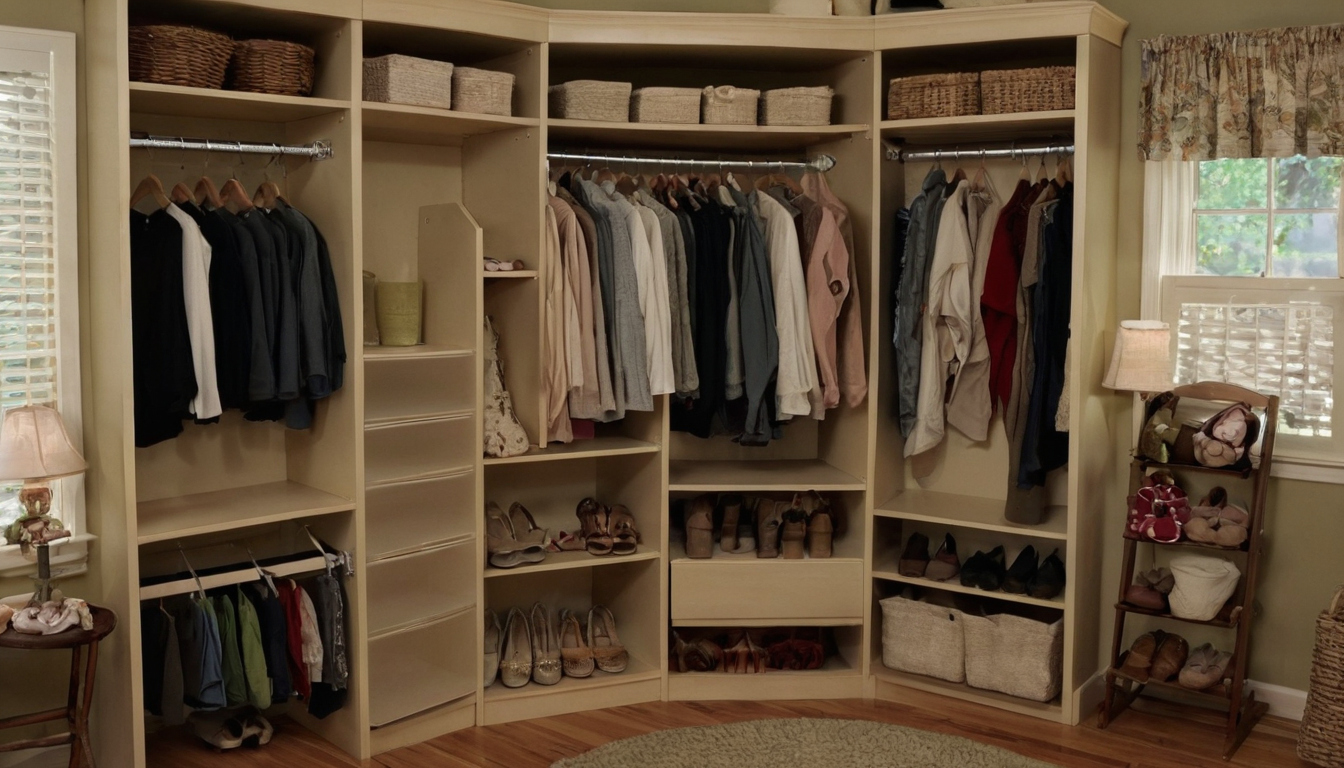
What should homeowners measure before planning closet organization in an older home shown with practical context cues.
How shallow is too shallow for a standard closet rod?
A closet is too shallow for a standard rod when clothes on adult hangers hit the door, back wall, trim, or each other during normal use, so judge the rod by usable depth rather than the age-old label of “closet.”
A shallow closet may work better with side-hanging, hooks, or shelves than a standard rod
Standard reach-in closets often work best near 24 inches deep, because many adult hangers span about 17 to 18 inches and bulky clothing needs extra clearance. A closet that measures 21 inches wall to wall may lose more space to baseboards, casing, sliding-door overlap, or a sloped back wall.
- Keep a standard side-to-side rod if hangers turn freely and the door closes without pressing garment shoulders flat.
- Use front-to-back or pull-out rods when a few shirts, uniforms, or guest coats need to face outward.
- Choose hooks for backpacks, robes, leashes, children’s jackets, and other grab-and-go items.
- Use shallow shelves for sweaters, jeans, linens, or bins; 12 to 16 inches deep often works better than a cramped rod.
- Avoid sealing damp items in bins until the closet has airflow. If repainting, adding adhesive panels, or using strong cleaners, the EPA recommends increasing ventilation when using products that emit VOCs.
The family test is plain: hang the bulkiest coat, close the door, then pull the coat out with one hand as if school or work starts in ten minutes. If that motion feels clumsy, shelves or hooks will serve the closet organization plan better.
Rod height should match the clothing type and the person using the closet
Rod height should follow the wardrobe. Single-hang rods commonly sit around 66 to 72 inches high, double-hang layouts often place rods near 40 and 80 inches, and long-hang sections for dresses or coats often need about 60 to 70 inches of drop. Children’s rods can sit lower so children can put away jackets.
Should an older-home closet use a modular closet system, custom closet shelving, or simple DIY parts?
An older-home closet should use the least complicated storage plan that fits the measured space, wall condition, budget, and household routine.
A closet system works best when the closet is square enough for standard modules
A modular closet system suits a closet with predictable walls, enough usable depth, and few interruptions. Many off-the-shelf systems rely on set-width towers, wall tracks, vertical standards, wire shelving, laminate panels, or brackets that adjust up and down but still need a workable rectangle.
Modular parts often work well in a reach-in closet with about 24 inches of usable depth, a clear back wall, and no radiator, sloped ceiling, or heavy trim interrupting the layout.
Custom closet shelving is most useful for shallow, sloped, or corner-heavy closets
Custom closet shelving earns its cost when standard modules waste space. A shallow closet may need 12- to 16-inch folded-clothing shelves, a side-hanging rod, or corner shelves shaped so a hand can still reach the back container.
Semi-custom or fully custom shelving is usually the higher-investment choice. Finish timing matters in a small enclosed space, so painted, stained, or solvent-based closet work should be planned with ventilation and cure time before clothes return.
A budget closet organization plan can phase rods, shelves, and shoe storage over time
A phased plan starts with function. An under-$100 refresh might add a stronger rod bracket, hooks, a small shelf, or a simple shoe rack. A midrange phase can add wall standards, wire shelving, laminate shelves, or a small tower. A higher-investment phase can add built-ins, drawers, fitted corners, and better lighting.
Purchase order matters: secure the rod first, add closet shelving second, solve shoe storage third, then choose bins, lighting, and door fixes. If lighting is part of the plan, ENERGY STAR states that qualified LED lighting uses at least 75 percent less energy and lasts up to 25 times longer than incandescent lighting: ENERGY STAR LED lighting guidance.
How should awkward closet corners be used without creating dead storage?
Awkward closet corners should hold items that match the corner’s access level, not the items a household reaches for every morning.
Corner planning starts with the access opening. A bin that is 13 inches wide may fit on a 14-inch-deep shelf, but it still needs hand clearance at the front and side. Avoid any layout that requires tilting a bin past sleeves, trim, or a door casing.
Blind corners should store low-frequency items in labeled containers
Blind corners suit seasonal clothing, guest linens, keepsakes, spare bedding, off-season shoes, and rarely used travel items. Blind corners do not suit school uniforms, daily shoes, diaper bags, sports gear, or the coat everyone needs on the first cold morning.
- Reach-in closet corner: use one or two clear boxes or fabric cubes with labels facing the door.
- Small walk-in corner: place low-frequency bins below waist height or above the daily hanging zone.
- Sloped-ceiling closet: use the lowest back corner for soft bags, folded blankets, or lidded bins that slide forward.
Shallow shelves often work with 10- to 12-inch-deep boxes, while deeper corner shelves can handle 14- to 16-inch bins if the opening stays clear. Old-house closets should not become chemical storage catchalls. The EPA advises buying only the quantity of VOC-emitting products needed for near-term use, especially paints, paint strippers, and solvents: EPA guidance on volatile organic compounds.
Short rods and hooks can make narrow side walls useful
Narrow side walls often work better with hooks, peg rails, or a short rod than with a full shelf. A 12- to 18-inch side rod can hold outfit planning, scarves, belts, a robe, or tomorrow’s work shirt without crowding the main hanging run.
Hook hardware should match the wall and load. Favor studs or solid blocking for heavy bags. If a family cannot grab the item with one hand, the corner should hold slower storage, not daily closet organization.
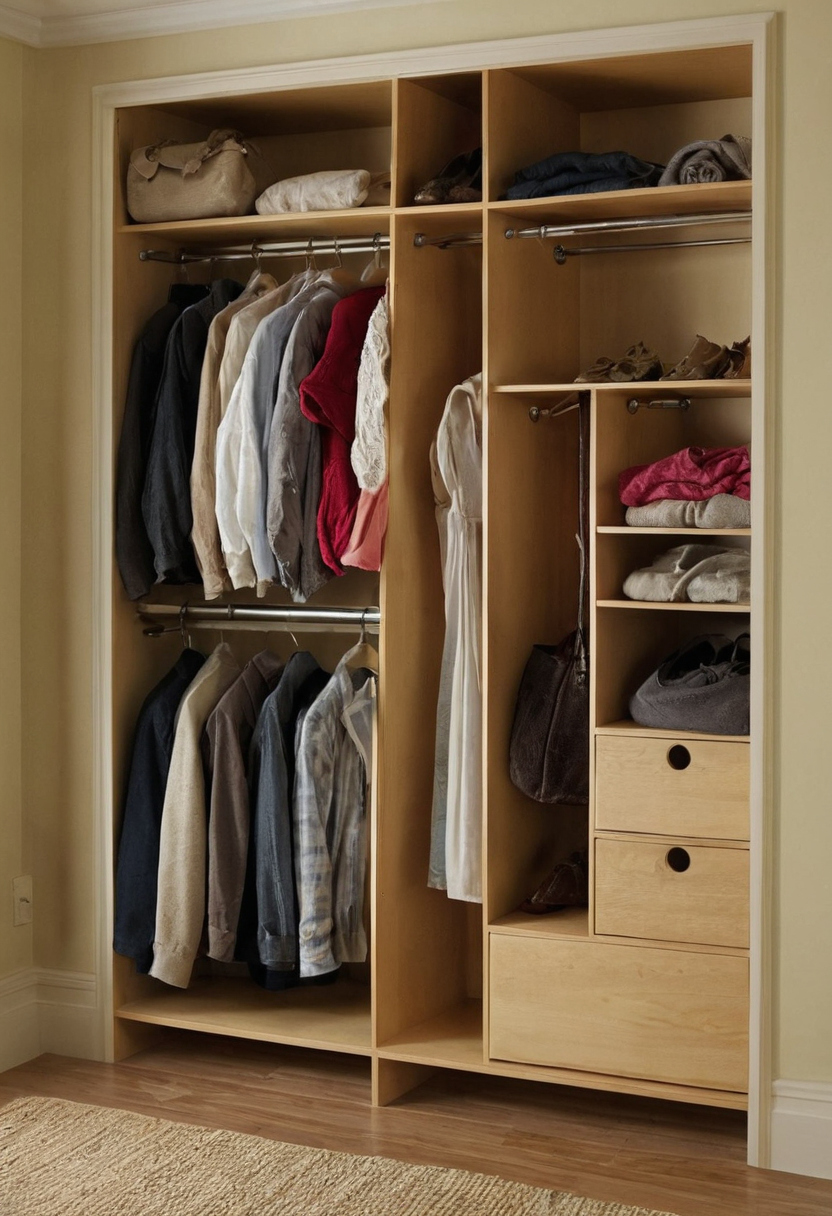
How should awkward closet corners be used without creating dead storage shown with practical context cues.
What shoe organizer for closet layouts work in shallow or narrow closets?
A shoe organizer for closet use should fit the closet’s usable depth, floor clearance, door movement, and daily shoe count before it is chosen for style.
Shoe shelves for closet floors should not block hanging clothes or door movement
Shoe shelves for closet floors usually need about 10 to 14 inches of depth for adult shoes, with children’s shoes needing less and tall boots needing more height. A two-tier rack may be only 12 to 18 inches tall, but that height still matters if coat hems, dresses, or laundry baskets already claim the floor.
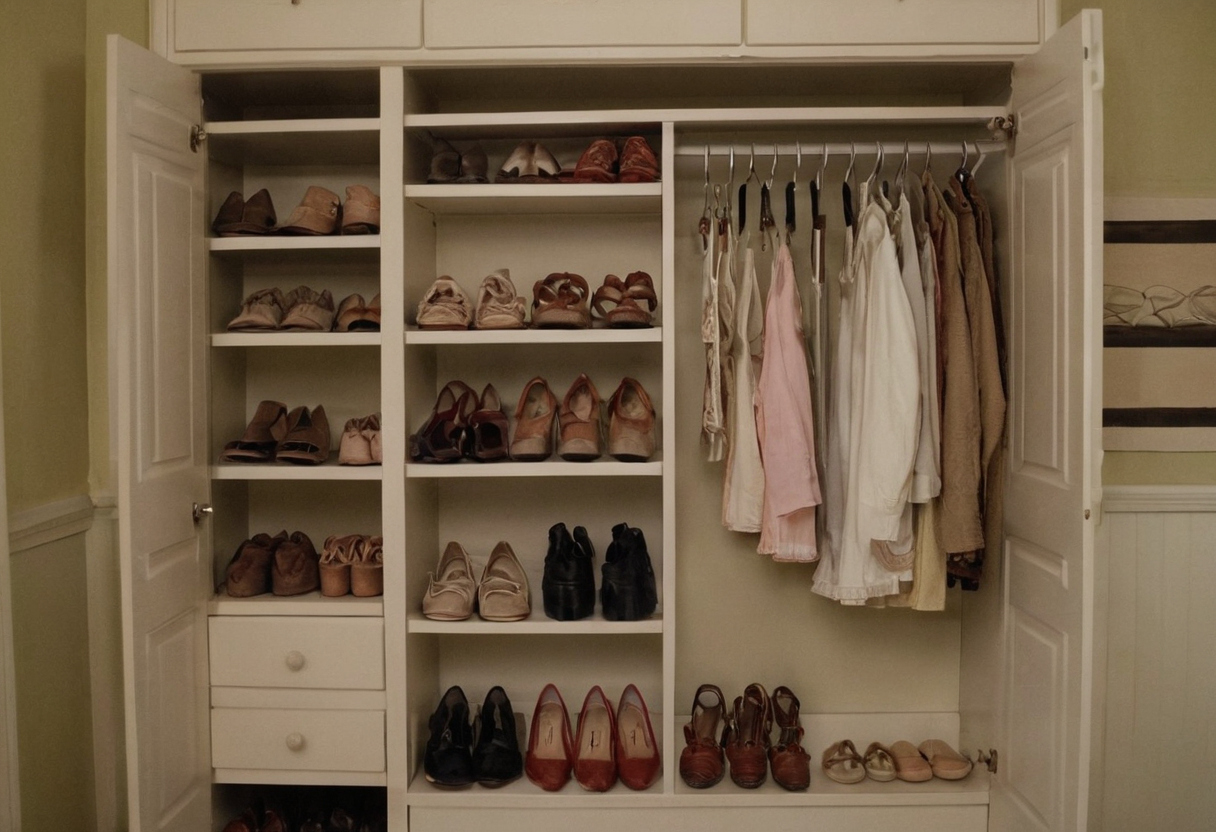
What shoe organizer for closet layouts work in shallow or narrow closets shown as an editorial planning reference.
Door swing is the first test in an older reach-in closet. If bifold doors scrape a rack or a hinged door knocks shoes sideways, the organizer will become a daily irritation. Over-door organizers can work for flats, sandals, children’s shoes, and gloves, but they can thicken the door enough to rub tight trim.
Seasonal shoe storage should move out of the daily access zone
Seasonal shoes should not occupy the best closet space during school mornings, workdays, or laundry catch-up. Keep work shoes, school shoes, sneakers, and one weather-ready pair near the floor or door. Store occasional shoes higher, farther back, or in labeled boxes.
Boots often behave better on a boot tray, in a mudroom, or on a top shelf with shapers than in shallow cubbies. Damp shoes need air before storage, especially in older closets that already feel cool or stale.
What wall, anchor, and load risks matter when installing closet shelving in an older home?
Closet shelving in an older home must be installed for the wall material, stud location, expected load, and shelf span, not just the product’s advertised capacity.
| Risk to check | Why it matters | Practical decision |
|---|---|---|
| Unknown wall material | Plaster, lath, masonry, and thin drywall hold fasteners differently. | Find framing first, then choose fasteners that match the wall. |
| Long rod or shelf span | Clothing weight can bow rods and pull brackets loose. | Add center supports and follow hardware span and load ratings. |
| Heavy storage zones | Coats, boots, bins, and denim weigh more than shirts. | Keep heavy items low, near studs, or on floor-based shelving. |
| Damp or musty closet | Closed storage can trap moisture around textiles and wood. | Fix moisture before adding bins, doors, or packed seasonal storage. |
Closet rods need center support when the span or clothing weight exceeds the hardware rating
Closet rods should be treated as loaded spans. Many reach-in closets need a center bracket once a rod stretches beyond roughly 36 to 48 inches, especially if the rod holds coats, uniforms, dresses, or tightly packed hangers.
Rod material, rod diameter, bracket style, and screw placement all change safe load. If the rod flexes during a test load, shorten the span, add a center support, or move heavy clothing to a lower, better-supported zone.
Plaster and lath closets need different fastening decisions than newer drywall closets
Plaster and lath walls can crumble around the wrong anchor, so older-home closet shelving should start with stud finding. Use a magnet, small pilot holes in hidden areas, or careful measuring from trim and outlets to locate framing, then fasten wall tracks or brackets into studs whenever possible.
Drywall anchors, toggle bolts, and masonry anchors have ratings, but those ratings depend on sound walls and exact installation. Brittle plaster, cracked corners, loose masonry, water-stained walls, or shelves planned for heavy bins are good reasons to call a carpenter before ordering a larger closet system.
Moisture, odor, and ventilation should be checked before adding closed storage
Older closets often sit against exterior walls, chimneys, bathrooms, or unconditioned spaces. Musty odor, condensation, peeling paint, rusted hardware, swollen baseboards, or spotted shoes should pause the shelving project.
The U.S. Environmental Protection Agency says wet or damp materials and furnishings should be cleaned and dried within 24 to 48 hours after water intrusion to help prevent mold growth. EPA mold guidance also says small mold areas under about 10 square feet can usually be handled by homeowners when no larger hazard is present: EPA mold guidance.
What is a practical one-weekend closet organization workflow for a shallow older-home closet?
A one-weekend closet organization workflow should empty, measure, sort, test, install only essential supports, and reload by access zone before any large closet system is ordered.
- Friday evening: empty the closet, bag obvious donations, and set aside anything damp, musty, broken, or out of season.
- Saturday morning: measure usable depth, rod height, side-wall reach, floor space, door swing, trim, vents, outlets, and ceiling limits.
- Saturday afternoon: test the layout with hangers, a sample bin, a shoe rack, and painter’s tape before drilling.
- Sunday: install the simplest reliable fix, then reload by daily, weekly, seasonal, and seldom-used zones.
The 80/20 wardrobe idea can guide access zones without forcing a full wardrobe purge
The 80/20 wardrobe idea means the easiest reach zones should hold the clothing worn most often, not every item owned. Work shirts, school uniforms, everyday jeans, pajamas, and laundry-return favorites belong between shoulder and waist height. Formalwear, backup coats, sentimental items, and off-season pieces can move higher, farther back, or to another closet.
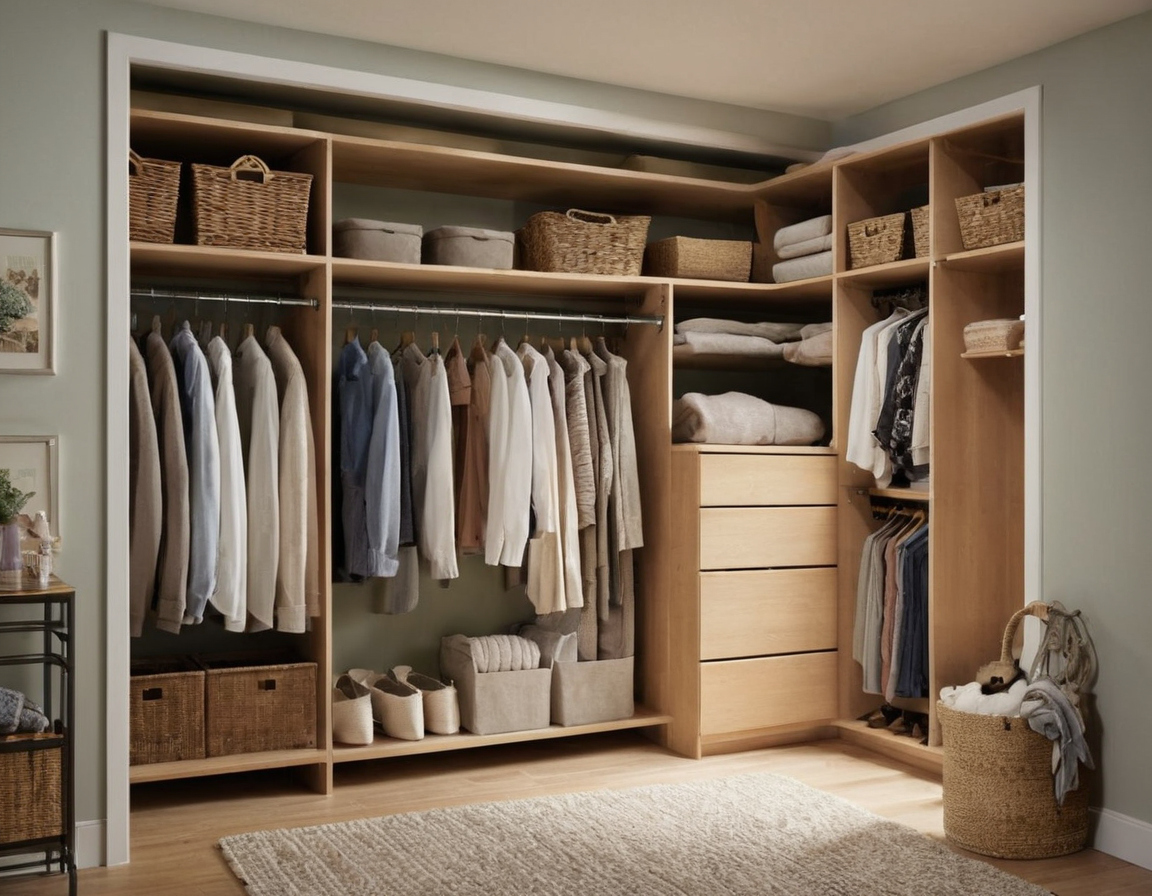
What is a practical one-weekend closet organization workflow for a shallow older-home closet shown with practical context cues.
A test-fit stage prevents expensive closet organization mistakes
A test-fit stage catches the mistakes product photos hide. Use painter’s tape for shelf lines, cardboard for bin footprints, a temporary tension rod for hanger swing, and one sample basket before buying a full set.
- Confirm the door opens without hitting shoes or bins.
- Check that hangers do not scrape the back wall or door.
- Reach into corners with one hand while standing naturally.
- Leave room for laundry day, backpacks, and seasonal swaps.
For seasonal maintenance, reset the closet every few months: remove outgrown clothing, rotate shoes, air the space, wipe shelves, and relabel bins. The lasting habit is simple: measure, mock up, and phase purchases before ordering a closet system.
FAQ
What is the shallowest depth that can still work for a closet?
A shallow closet can still work if the storage matches the depth. Standard hanging usually wants close to 24 inches, but shelves, hooks, front-to-back rods, and folded storage can work in shallower spaces.
What should homeowners do with a very shallow closet?
Use the closet for folded clothing, linens, hooks, side-hanging, or slim shoe storage instead of forcing a full-width rod. Keep the daily items closest to the opening.
How far can a closet rod span without support?
Many common rods need center support around 36 to 48 inches, especially with heavy clothing. Follow the hardware rating and add support if the rod flexes.
What is the 80/20 rule for wardrobe organization?
The 80/20 idea means the clothes worn most often get the easiest reach zones. Less-used clothing moves higher, farther back, or into labeled seasonal storage.
Are shoe shelves for closet floors better than an over-door shoe organizer in a narrow closet?
Shoe shelves are better when the floor has clear depth and hanging clothes will not bunch. Over-door organizers are better when floor space is tight, but only if the door still closes cleanly.